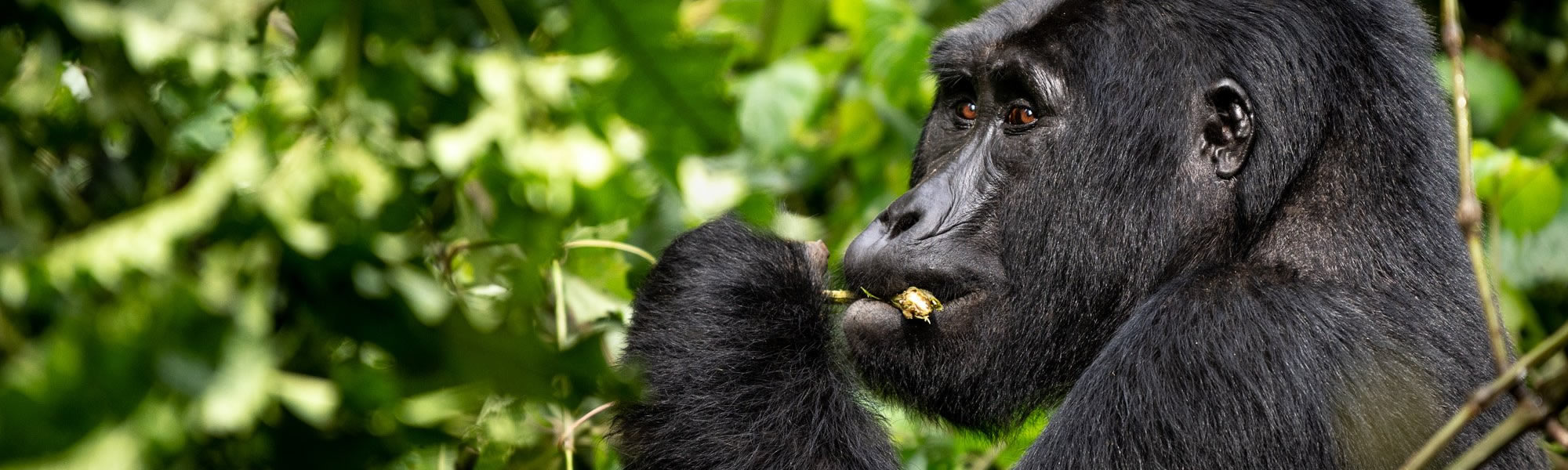
10 facts about Mountain Gorillas
For visitors interested in taking on a mountain gorilla trekking experience, there are 10 facts about mountain gorillas you should have in mind.
Mountain gorillas are endangered primate species and can only be found in a few places in the world. In Africa, the endangered mountain gorillas are located in the Virunga Conservation Area in the east region.
This area stretches from the Democratic Republic of Congo to Rwanda and Uganda. The Virunga Conservation Area consists of national parks like Virunga National Park in Congo, Volcanoes National Park in Rwanda, Bwindi Impenetrable National Park, and Mgahinga Gorilla National Park both in Uganda. The following are some of the 10 facts about mountain gorillas.
- Mountain gorillas are endangered primate species and only about 850 are left in the entire world. Uganda, a country located in the eastern region of the African continent, has over half of the entire world’s population of mountain gorillas. These mountain gorillas are divided into two parks that are Bwindi Impenetrable National Park and Mgahinga Gorilla National Park. Bwindi Impenetrable National Park is home to over 480 mountain gorillas and about 100 mountain gorillas occupy Mgahinga Gorilla National Park.
- Mountain gorillas live in montane vegetation areas and also bamboo forests. They are highly concentrated in the mountainous region and thus named mountain gorillas.
- Mountain gorillas are social beings that live in groups known as families and each family is headed by a large male mountain gorilla called a silverback. Each family in most cases has one silverback that protects and defends the entire family but there are some cases where families have more than one silverback. In this case of having multiple silverbacks in one family, there is always one dominant silverback that controls the entire family and defends it from intruders.
- Mountain gorillas share about 98% of DNA with human beings. Among the primate species of the world, mountain gorillas are some of the primates that are closer to humans than other primates. This means that genetically mountain gorillas have the same likeness as humans. This is why when taking on a mountain gorilla trekking experience, you must be very healthy and not have any diseases especially air bonne disease because you can easily spread it to the mountain gorillas.
- Mountain gorillas are massive beings and the largest primates on earth. They are also the most powerful primates among the primate species in the world. A fully grown silverback can weigh as much as 180 kilograms and stretch to 5.5 feet in height while standing on all of its four legs. This means that a silver weighs much more than a fully grown healthy man and at the same or much more height. Female mountain gorillas are slightly lower in weight than the males. They can weigh up to 90 kilograms and have a height of about 4.9 feet.
- Mountain gorillas eat massively on a large scale to keep their massive bodies going and healthy. They can spend the entire day eating and resting at night. An average mountain gorilla can eat as much as 22 kilograms in a day that is for a silverback but females eat slightly lower than that. Their diet is mainly made up of bamboo leaves and leaves from other plants, shoots, stems, tree barks, and other vegetation. However, mountain gorillas are not only vegetarians they can also feed on small insects like ants, insect larvae, and snails among others.
- When it clocks nighttime, the mountain gorillas normally make a nest in the trees and also on the ground. They sleep together for warmth and also the young ones sleep together with their mothers in one nest for warmth.
- Mountain gorillas can live for over four decades if they are not killed by disease or fights among themselves. Female mountain gorillas can reproduce when they clock 10 years and they take nine months in gestation. This means that the females can produce an infant every after 4 years and infancy takes three and a half years. After about eight years, the females are adults and the males are considered blackbacks. From the age of eight years to ten, the blackbacks turn to silverbacks because of the silver-like hair that grows on their backs. This is the period when these silverbacks move out of their families to start their own or overthrow their fathers.
- Mountain gorillas can go for days without drinking water. This is because they feed on plant leaves and shoots which are heavily moist and thus hydrating their massive bodies. It is on very rare incidents that you can find mountain gorillas drinking water.
- Mountain gorillas are very calm and gentle species. It is in very rare cases that mountain gorillas will charge at people or other animals. They are very calm and often live in harmony with their neighbors in the forest. Silverbacks often act aggressively, especially when defending their family from intruders but they even first warn so unless the warning is ignored they cannot attack. There are hardly any cases of silverbacks charging at visitors because if you do not show aggression and lower yourself they won’t attack. Silverbacks beat their chests and use vocalizations like roars and hoots to show dominance and warn their intruders.
Mountain gorillas are the most endangered primate species. Their biggest threat is encroachment on their habitats by humans. Due to the population growth of people, there is a need for land for agriculture and expansion. This has led to human encroachment on the habitats of these mountain gorillas and brought up conflict with them.
Another huge threat is the poachers that kill these mountain gorillas for bush meat. However, the good news is that there have been strict measures put in place such as conservation and protection efforts that have yielded benefits because the mountain gorillas are multiplying in the wild.