
Brief History and Origin
The Karamojong people are located in the northeastern region of Uganda in the Karamoja sub-region. The Karamojong people are traditionally pastoralists that look after cattle and they are part of the Nilotic group of people. The districts of Kaabong, Napak, Amudat, Napak, Moroto, and Nakapiripirit fall in Karamoja sub-region occupied by the Karamojong.
The Karamojong people are believed to be part of the Nyangatom people of Ethiopia who in 1600 AD divided into two groups one settling in Uganda that is the Karamojong and in Kenya the Turkana people.
The Karamojong are believed to have originated from Abyssinia in the early 1600-1700 AD and split into different groups and settled in South Sudan, Uganda, Kenya, and Ethiopia among others. The Karamojong people got their name from the language they spoke known as Karimojong
The Karamojong Culture and lifestyle
The Karamojong people are the tallest in Uganda and just like the Maasai and Turkana of Kenya, they tend to have facial markings on their faces as a symbol of beauty and ethnic myth. The Karamojong are very dark-skinned because of the hot sun they live in.
They wear different brightly colored clothes according to age. The young and energetic men put on a vest and warp themselves with a checked-colored cloth around their waists. The Karamojong people are traditionally nomadic pastoralists who practised nomadic pastoralism.
This is a practice of moving from place to place looking for pasture and water for the animals. They practised nomadic pastoralism because of the arid climate conditions of the Karamoja sub-region, the area where they live. The land was also communally owned so this alone favored the practice of nomadic pastoralism. The Karamojong people are cattle keepers and wealth in their culture is measured by the many herds of cattle one has. This has led to practices like cattle rustling which has led to many conflicts, especially among their neighbors in Kenya the Turkana.
Cattle rustling has been rampant over the years because it was seen as an act of bravery to raid neighboring communities and villages to loot their cattle. Selected Karamojong warriors from their community armed with weapons like spears, bows, arrows, and AK47s among others participate in this act of cattle rustling. The Karamojong give away cattle gifts to their close associates and even bride price when going to marry so to increase the number of cattle one has, they raid their communities. The Karamojong people in Uganda are the only ethnic group of people that has not bowed to Western civilization and modernity. The Karamojong people guard their heritage and culture from outsiders.
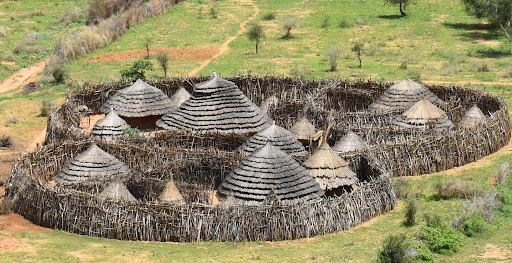
There were government programs that were put in place to develop the Karamoja area but the efforts fell out. As earlier mentioned the Karamojong people survive on rearing cattle by drinking milk, ghee, yogurt, blood from cows, roasted hides, and meat. The Karamojong people live together in homesteads locally known as manyatta. These homesteads are looked after by the women. The Manyatta is considered a nursery for young girls and boys to develop their culture by looking up to their elders.
Young girls spend much of their time with their mothers and older women who groom them with the values of the Karamojong and the responsibility of a woman in the Manyatta. However, the young boys often move with their fathers to look after the
livestock and learn the benefits of the livestock in their lives. They learn to milk, and puncture cows for blood which is mixed with milk or eaten alone.
The women in the Karamojong culture are the caretakers of the homestead and are also in charge of planting and cultivating crops for food. They even build and renovate their houses and the entire manyatta and also fetch water and firewood from the fields
to prepare meals for their household. On the other hand, the men are in charge of rearing the livestock by moving to places in search of pasture and water. They are even in charge of protecting their livestock from raids and other cattle rustlers from neighboring communities like the Turkana. In the evening when the men return with their livestock, the livestock is put in their kraal which is in the middle of the manyatta and they light a campfire in the middle of their livestock.
A Karamojong warrior is then selected to keep an eye on and guard them in the night from the intruders and the other cattle rustlers. Marriage in the Karamojong people is an anticipated event where mature young men showcase their potential to protect their homestead by wrestling it out with the potential women they are to marry. After the wrestling match is done and it favors the man, he, therefore, presents the bride price to the father of the woman he is to marry in the form of livestock such as cows, goats, and sheep.
In the case where the woman defeats the man, the man is seen as weak and unable to protect his home from intruders and therefore rejected and laughed at by his peers and the other members of the community. This is done to encourage and build the spirit of
bravery among the youth. Due to the insecurity of the cattle rustlers and also political insecurity, the Karamojong region has been seen as a dangerous zone for outsiders. The government programs of disarming the Karamojong people have thus yielded fruits of security back to the region and opened up doors to tourism. This has also led to small developments in the Karamojong communities.
Over the recent years, the Karamojong people have opened up their culture to tourism for both educational and leisure purposes. While on a Uganda safari experience, you may as well visit the Karamojong people in their communities and see their manyatta
homesteads, you can also observe the wrestling contest between the mature youthful men and women in search of a potential marriage partner. The Karamojong culture is the only culture that has not been affected by Western civilization in Uganda, it is interesting to see their people preserving their traditional norms and values in modern times.
